
Retail EDI: What It Is & How Big-Box Vendors Use It

You’ve heard of EDI, but you’re not sure what it is exactly? Picture this: retail EDI is the language big-box retailers speak, and if your systems cannot speak it back, your product does not reach the shelf. Before a pallet moves, retailers like Walmart, Amazon, Home Depot, Lowe’s, and Menards expect orders, shipping notices, and invoices to flow between computers in a digital, standardized format.
If you understand how EDI in retail flows, though, it becomes your on-ramp to the country’s largest retailers, not a hurdle. Read on to learn what retail EDI is, how big-box vendors actually use it, and how you can keep your shipments compliant from the first purchase order to final payment.
TL;DR
- Retail EDI is the standardized, computer-to-computer exchange of documents like purchase orders, shipping notices, and invoices between vendors and retailers.
- Big-box retailers mandate it to move high order volumes quickly and accurately, in a format their systems read automatically.
- A core set of transactions does the work: the 850, 855, 856, 810, and 997.
- The fastest route onto the shelf is a fulfillment partner already EDI- and API-ready.
The Basics: What Is EDI In Retail?
EDI stands for Electronic Data Interchange. It plays a pivotal role in retail supply chains, as it allows two companies to swap business documents directly between their systems (computer-to-computer) in a standard format, with no paper and no re-keying. A retailer creates a purchase order and sends it straight into the vendor’s system, which reads it automatically. In North America, this primarily runs on the ANSI X12 standard. The payoff is fewer errors, faster orders, reduced costs, and paperwork a retailer accepts on the first try.
Why Retail EDI Runs The Big-Box Supply Chain
A big-box retailer handles thousands of vendors and millions of units, with orders moving every hour. Manual processing cannot help scale on that level; EDI can. Market insights are pretty self-evident: the global EDI software market was worth about 2.31 billion dollars in 2025 and is projected to reach 6.49 billion by 2034, at a 12.3% annual rate, with North America holding more than half that spend. Retail is the single largest industry using EDI, at roughly 28%. EDI in the retail industry is an entry ticket.
The Core Retail EDI Transactions Every Vendor Meets
Every EDI document comes with a number, and those numbers are the exact specifications your retailer’s routing guide will require. On a daily basis, a retail vendor lives and deals with a defined core of transaction sets:
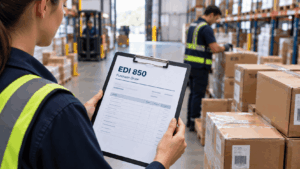
- 850 (Purchase Order): the order, with items, quantities, pricing, ship-to locations, and required arrival date.
- 855 (PO Acknowledgment): your confirmation that you can fill it.
- 856 (Advance Ship Notice, or ASN): the heads-up before the truck arrives at the retailer’s distribution center, detailing what ships and how it is labeled.
- 810 (Invoice): your bill, which must reconcile with the order and the ASN.
- 997 (Functional Acknowledgment): the receipt confirming each document landed.
- Others appear as you scale, such as the 846 (Inventory Inquiry/Advice) and 860 (PO Change).
How The Retail EDI Flow Works, From PO To Payment
The retail EDI flow is really an order-to-cash cycle. The retailer transmits an 850, you confirm with an 855, and the order moves into picking and packing, where EDI for retail procurement meets physical retail and eCommerce fulfillment. Then you send the 856. To get it right, it must go out before the goods reach the distribution center on one hand, and match the shipment exactly on the other hand. The goods ship, the 810 follows, and 997s confirm every handoff. Nail the sequence and orders clear cleanly, payment arrives on schedule, and your scorecard stays healthy.
Interested in our Services? Get a Custom Quote that completely suits your needs.
GET STARTED!
The Strictest Test in Retail: Walmart EDI
If you can pass Walmart, you can pass almost anyone, since Walmart EDI requirements set the bar the rest of retail measures against. Walmart trades over ANSI X12 using the AS2 protocol, with the 850, 855, 856, 810, and 997 as core documents. That is the baseline for Walmart EDI integration. The harder part is performance: its On-Time, In-Full program commonly holds suppliers to a 98% threshold, and shortfalls can trigger an automatic chargeback of roughly 3% of the cost of goods on the non-compliant portion.
Here is the catch: the 856 (ASN) causes the most chargebacks, so a late or mismatched ASN triggers a penalty. The good news is every chargeback is preventable. Get the data right and out on time, and Walmart EDI compliance takes care of itself, especially with a partner that knows how to help you scale through compliance intricacies.
Getting Retail EDI Integration Right With The Right Provider
Most EDI failures are the same few issues repeated: late or inaccurate ASNs, mapping errors, and treating retail EDI integration as a one-time setup when routing guides change constantly. The fix is validated connections, ASNs built from real pick-and-pack data, and continuous monitoring, in a way that EDI compliance for retailers becomes routine.
That viewpoint should shape the way you compare the top EDI service providers for the retail industry. One path is standalone EDI software, where you own the mapping and compliance in-house. The other is a fulfillment partner already EDI- and API-ready, with connections and ASN accuracy built into shipping and logistics. Either way, the checklist is the same: established connections, real-time visibility, and a track record of hitting OTIF.
Why DPWagner Is A Solid Partner Choice: Retail EDI Built Into Fulfillment
DPWagner is 100% EDI- and API-ready, and receives orders via EDI and API from all major retailer platforms. The real difference is where our compliance knowledge comes from: we ship our own retail brands into the same big-box stores our clients want to reach, so we live retailer compliance, labeling, and routing rules from the inside, and apply changes the moment they land. From our core Atlanta operation, we focus on one goal: 100% on time, in full, with the EDI connections and physical retail 3PL work under one roof. No guessing. No gaps.
Retail EDI does not have to slow your big-box launch. Whether you are scaling, switching from a 3PL that never mastered the rules, or entering US retail for the first time, DPWagner connects the data and the fulfillment so your product lands, compliantly.
FAQ
What is EDI in retail, in plain terms?
The standardized, computer-to-computer exchange of documents like purchase orders, shipping notices, and invoices between a vendor and a retailer, in a format both systems read automatically.
Which EDI documents does Walmart require?
The core set is the 850, 855, 856, 810, and 997, with others such as the 846 for dropship programs as you scale. The 856 (ASN) is the most compliance-sensitive.
Is retail EDI the same as an API?
No, though they work together. EDI handles high-volume, structured transactions like orders and invoices; APIs handle real-time updates like live tracking. Most retail operations use both.
Do I still need an EDI provider if my 3PL is EDI-ready?
Often not. If your partner maintains validated retailer connections, the transactions, ASN accuracy, and monitoring can run as part of fulfillment. Ask what OTIF results they can show.