

Safety Stock: The Buffer That Keeps You From Running Out
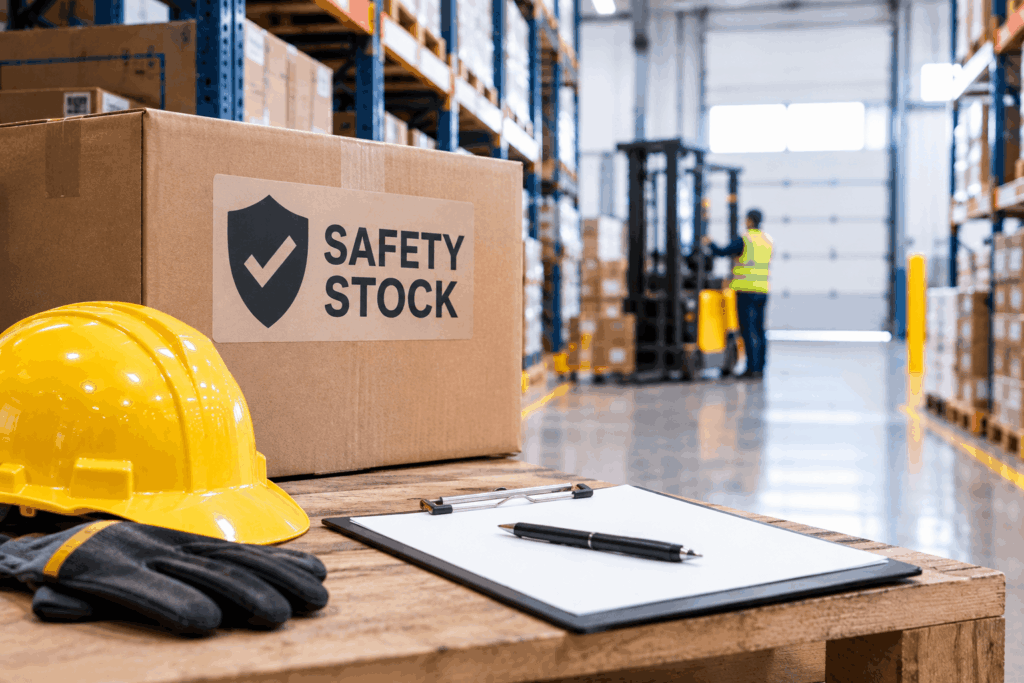
A purchase order from Lowe’s asks for 4,000 units. You have 3,650 on the floor, and the next container clears customs in eleven days. So you ship what you have, the order goes out short, and the fill rate column on your scorecard moves the wrong way.
The missing 350 units are the smallest part of the problem. The rest is harder to win back: a point of fill rate, a deduction against your remittance, and a buyer with a fresh reason to review your line. Safety stock exists to stop that sequence, and the arithmetic behind it is straightforward. The harder question is where those units sit and how fast they move once the PO lands.
TL;DR
- Safety stock is inventory held above forecast demand to absorb the two things nobody predicts perfectly: how much sells, and how long replenishment takes.
- For a retail supplier, running out is not a lost sale. It is a fill rate miss, a chargeback, and a conversation about shelf space.
- Three formulas cover most situations: average-max, service level, and variable lead time. Choose by whichever input actually swings in your business.
- Protection gets expensive fast. Moving from a 95% service level to 99% takes roughly 41% more buffer stock.
- Safety stock only counts if it can ship compliantly on short notice. Units still on the water, or in bulk cartons that need labeling, are inventory rather than protection.
What Is Safety Stock, In Simple Terms?
Here is the safety stock definition without the textbook wrapping: it is the inventory you keep on top of what your forecast says you will sell, so a bad week does not leave you with nothing to ship. Every replenishment cycle runs on two estimates, your demand forecast and your supplier’s lead time, and both carry error. Safety stock inventory covers the gap between those estimates and what really happens.
Carrying a buffer is not a sign of sloppy planning, either. Across US retail as a whole, inventories sat at 1.25 months of sales in June 2026. Holding more than you expect to sell this month is simply how the retail system works.
Safety Stock vs Cycle Stock
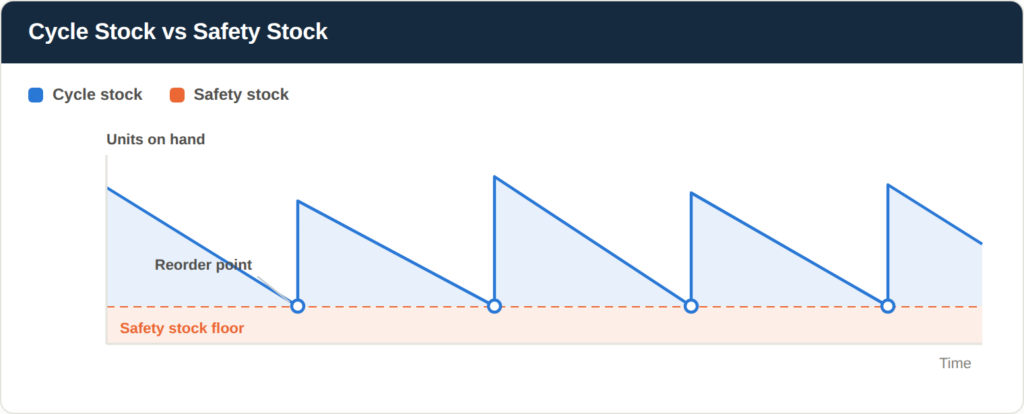
Cycle stock is what you plan to sell between deliveries, and it should run down close to zero before the next one lands. Safety stock sits underneath it and is not meant to be touched. Dipping in now and then is just the system working. Dipping in every cycle means your forecast or your lead time assumption is off, and a bigger buffer will only hide that a while longer.
What The Buffer Is Actually Protecting
For a direct-to-consumer brand, an out-of-stock costs one order. For a brand selling into Walmart, Home Depot, Lowe’s, or Menards, the damage lands somewhere far less forgiving:
- Fill rate. Retailers score the percentage of ordered units you delivered, and a short shipment shows up the same week.
- OTIF. On-time in full counts a partial delivery as a failure, even if the truck arrived early.
- Deductions. A shortfall usually returns as a retail chargeback, assessed as a percentage of purchase order value, so your largest POs carry the largest exposure.
- Shelf space. Buyers give facings to suppliers who ship complete, and that reallocation rarely gets announced.
Given all of the above, the buffer belongs in a US warehousing position you control, not on a vessel you are tracking by email.
Safety Stock Calculation: Three Formulas Worth Knowing
There is no single safety stock equation. The right method depends on which number is less predictable in your business: how much you sell, or how long your supplier takes to deliver.
1. The Average-Max Method
Safety stock = (Max daily sales × Max lead time) − (Average daily sales × Average lead time)
The most direct way to calculate safety stock, and a sound starting point when you have clean sales history but no appetite for statistics. Say a particular SKU sells 60 units a day on average and peaks at 100, while your supplier averages 5 days and has stretched to 7:
(100 × 7) − (60 × 5) = 700 − 300 = 400 units
That covers the worst version of both inputs landing at once.
2. The Service Level Method
Safety stock = Z × standard deviation of demand × √(average lead time)
Most planning software uses this method, and it is the one worth understanding since it lets you dial protection up or down deliberately. Z turns your chosen service level into a number the formula can use. A 95% service level means you accept running out in roughly 5 of every 100 replenishment cycles. At 99%, that drops to 1 in 100.
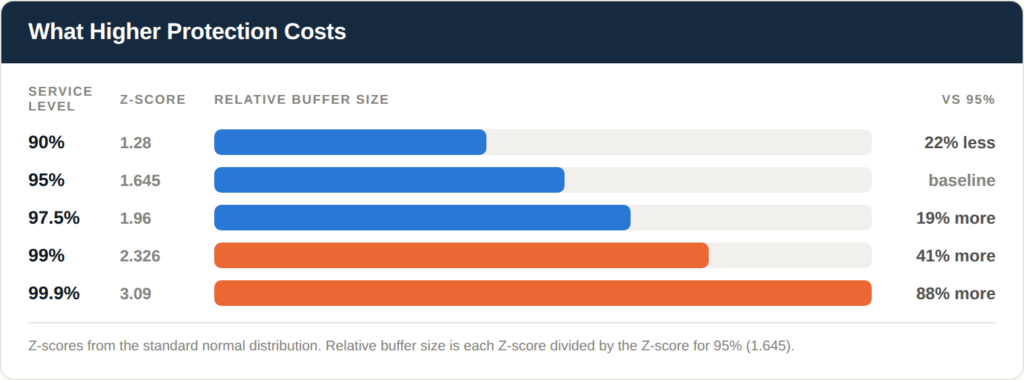
The final percentage point of certainty costs far more than the first ninety, and that is where inventory budgets go quietly wrong. Most retail suppliers land between 95% and 99%, choosing a level for each SKU rather than one for the whole catalog. Your best sellers, and anything a retailer fines you for shorting, get the higher number. Slow movers get the lower one.
3. The Variable Lead Time Method
Safety stock = Z × Average daily sales × Standard deviation of lead time
Reach for this one when demand is steady but supply is not: imported goods, single-source manufacturing, anything with a seasonal production window. It is a long-established approach, set out in operations texts such as Heizer and Render’s.
Where Safety Stock Meets Your Reorder Point
Reorder point = (Average daily demand × Average lead time) + Safety stock
Safety stock tells you how much cover to hold. The reorder point tells you when to go get more. Both depend on knowing what you have right now, by SKU, across every channel, which is why our real-time order management views exist: you reorder on live numbers, not last Friday’s spreadsheet.
The Two Inputs That Decide Your Number
How Much Does Demand Move?
Retail demand does not drift gently. A promotion, a store count change, or a seasonal reset can double a week’s volume with little warning. Pull at least twelve months of history per SKU, calculate the standard deviation, and treat promotional weeks as their own category rather than folding them into the average.
How Much Does Lead Time Move?
This is the input brands underestimate most. In 2024, Red Sea rerouting sent ships around the Cape of Good Hope and turned a few days into several weeks. As a result, ton-miles hit a record and rose 6%, even as volumes grew only 2.2%. Same cargo, longer clock.
Then add the domestic half: inbound transit, receiving, and the appointment window at the retailer’s distribution center. Each stage carries its own variability and belongs in your lead time deviation, measured against the published retailer compliance requirements rather than the optimistic version.
Why The Number Is Only Half The Answer
Suppose the math lands you on 400 units. Whether those 400 units protect you depends on questions no formula asks:
- Are they in the country? Safety stock in a container is a plan, not a buffer.
- Are they retailer-ready? Correct case pack, current GS1-128 labels, and pallet specs that match the routing guide.
- Can someone pick cases, not just pallets? Most short-fill emergencies need partial pallets built fast.
- Can they be reworked? Relabeling, kitting, or repacking a buffer built for one retailer so it satisfies another.
- Can you see them in real time? A buffer you cannot count is a buffer you will not trust.
Our own retail brands keep their safety stock on these racks, a few aisles from our clients’ inventory, answering to the same routing portals and store-set dates. So these questions are not a checklist we hand you. They are ones we have answered for our own purchase orders for more than 25 years, which is how our retail distribution services learned to turn a buffer into a compliant truck the same week it is called for.
A Buffer That Ships Beats A Buffer That Sits
Calculating safety stock is a finance exercise. Making it count is an operations issue. Brands that get both right hold less inventory and miss fewer orders, because their buffer sits where a short-notice PO can reach it.
Ready to put your buffer stock somewhere it can move? Tell us your SKUs, your retailers, and your lead times, and we will size the 3PL program around them. No guessing. No gaps.
Interested in our Services? Get a Custom Quote that completely suits your needs.
GET STARTED!
Frequently Asked Questions
What is safety stock inventory?
It is the portion of your inventory held deliberately above forecast demand, reserved for the weeks when sales run hot or replenishment runs late. It is separate from cycle stock, which is what you plan to sell between deliveries.
Which safety stock formula is the most accurate?
None is accurate on its own, because each of them assumes something different stays still. Average-max ignores the shape of your demand curve. The service level method assumes demand varies in a predictable bell-curve pattern. The variable lead time method assumes demand itself is steady. Pick whichever assumption comes closest to true for that SKU, then check the result against what actually happened next quarter.
How do you find safety stock for a SKU you have just launched?
Without sales history, the statistical methods have nothing to work with. Start with a fixed buffer based on the retailer’s expected order size and your supplier’s quoted maximum lead time, and then move to the average-max or service level method once you have three to six months of real data.
Is too much safety stock a real risk?
Yes. Excess buffer ties up cash, fills racking you are paying for, and ages into markdown territory. Plus, it can mask a forecasting problem for months. Recalculate quarterly for stable categories and monthly for seasonal ones, plus any time a supplier changes lead time or a retailer adds doors.
Can a 3PL hold safety stock for several retailers at once?
Yes, and it is usually the cheaper arrangement. One pooled buffer serves several retail programs, provided the operation can label, case pick, and build pallets to each retailer’s specification on demand.