
What Is B2B Fulfillment? How It Works & What To Look For
Wondering what B2B fulfillment is exactly, and in what ways does it differ from B2C? In this article, we’ll explore its modus operandi and see what sellers should look for when searching for a reliable 3PL fulfillment partner. Let’s jump right in with a familiar wholesale fulfillment story that will undoubtedly sound familiar to many vendors.
After arduous efforts from the sales team, a pet supplies company finally manages to secure a contract with a big-box retailer. Everyone’s excited and working non-stop to prepare the first shipment!
The company decides to work with a third-party logistics (3PL) partner. They send their inventory to the 3PL’s B2B fulfillment center, and things get underway. A couple of months later, when their first payment is due, they notice a chargeback deduction on the invoice! What went wrong? Their 3PL, who specializes in ecommerce parcel volume, has never touched a big retailer routing guide before. Due to this inexperience, they underestimated their carrier’s transit time and missed the dock delivery window. A mistake that could have easily been dodged with retail fulfillment experience.
TL;DR
- B2B fulfillment ships bulk orders between businesses. Pallets on freight to a retailer or distributor, not parcels to shoppers.
- Compliance beats speed. Business buyers grade you on the right quantity, labeled and documented correctly, delivered in the assigned window. Early can hurt as much as late.
- Retail fulfillment is the hardest kind. Big-box retailers enforce strict routing guides and On-Time, In-Full (OTIF) rules, and mistakes become chargebacks and penalties.
- Chargebacks are routine, not rare. Vendors can lose roughly 1-3% of gross sales to deductions, and repeat problems can cost shelf space.
- The right partner makes retail profitable. Proven relationships with retailers, full EDI, and compliance experience protect your margin.
B2B Fulfillment, Defined and Explained
To put it as simply as possible, B2B fulfillment is the process of moving products from one business to another. Instead of one item going to one person, large, palletized quantities are moved from a supplier to another business (a retailer, a wholesaler, or a distributor) that will resell the product. Forget the idea of a parcel on a porch; in B2B, freight is being delivered to a loading dock.
If you want to get a glimpse of how massive B2B order fulfillment is as a market, try to wrap your head around the following numbers: U.S. merchant wholesalers -the brands and distributors that supply retailers- posted sales of $722.1 billion in December 2025 alone, according to the U.S. Census Bureau. Plus, the warehouses that store and ship all those goods now make up a $232.1 billion U.S. market.
The Main Differences Between B2B and B2C Fulfillment
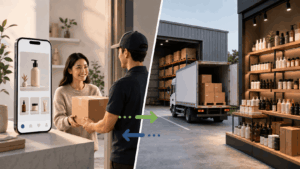
The key differentiator between B2B and B2C in fulfillment is speed and the buyer’s profile. Each has their own set of requirements and expectations.
The B2C Individual Shopper
In B2C, you have an individual shopper that places an order online. A warehouse somewhere picks the item, packs it, and a carrier drops it on their porch a day or two later. Usually, this is enough to make the customer happy.
The B2B Wholesaler
In wholesale order fulfillment, customer satisfaction is an entirely different game. The customer is another business with a purchasing system, a contract, and a detailed set of rules. And it measures you on accuracy and compliance.
| Aspect | B2B Fulfillment | B2C Fulfillment |
| Customer | Retailers, wholesalers, distributors, corporate buyers | Individual consumers |
| Order size & volume | Large bulk orders, placed less frequently | Small orders, high daily volume |
| Shipping method | Palletized freight (LTL/FTL); parcel only for smaller orders | Individual parcels to residential addresses |
| Delivery | Pre-scheduled DC appointments and Must-Arrive-By dates | Flexible delivery, as fast as possible |
| What’s prioritized | Accuracy and compliance | Speed and convenience |
| Compliance | Strict: EDI, routing guides, labeling, OTIF; errors trigger chargebacks | Minimal |
| Packaging | Bulk or retail-ready, customized to each retailer’s specs | Standard branded boxes |
| Technology | EDI, API, ERP integration | Ecommerce platform plugins |
| Relationship | Long-term contracts, negotiated terms, dedicated account management | Transactional, one-off |
| Payment terms | Invoicing on net terms (Net 30-60) | Immediate (card, wallet) |
| Returns | Fewer but complex (RMAs, pallet-level restocking) | Frequent, fast, simple |
| Cost & handling | Higher – more labor, equipment, and specialized handling | Lower, with faster turnaround |
Interested in our Services? Get a Custom Quote that completely suits your needs.
GET STARTED!
How Does B2B Order Fulfillment Work?
Here is the sequence of actions typically employed at a B2B fulfillment center:
Order receipt via EDI/API/portals
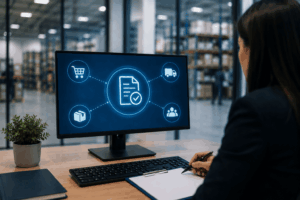
A B2B order typically arrives electronically as a purchase order through EDI, an API integration, or an online ordering portal, often against a standing contract or negotiated pricing agreement.
Inventory management and warehousing
Inbound products are received, counted, and stored in the warehouse, with stock levels tracked in real time so available inventory always reflects what can actually be promised to buyers. At this point, reliable inventory data is what prevents the most common downstream problem: accepting an order that can’t be shipped complete and on time.
Allocation and value-added preparation
Once an order is confirmed, stock is allocated to it and prepared to the buyer’s specifications, which can include kitting, assembly, custom packaging, or labeling. This prep step is where a fulfillment operation adds value, transforming raw inventory into order-ready products that meet each customer’s particular requirements.
Compliance and documentation
Most B2B shipments must travel with accurate supporting paperwork, such as an Advance Ship Notice (ASN), a Bill of Lading, packing slips, and standardized barcode labels. All prepared to the buyer’s specifications. Getting this documentation right is essential, because incomplete or inaccurate paperwork can delay receiving, hold up payment, or trigger penalties, with requirements becoming especially strict for larger retail and enterprise buyers.
Pick, pack, and palletize
Workers pick the allocated product, pack it according to the order’s case and carton requirements, and consolidate it onto pallets for bulk shipments or into cartons for smaller ones. Accuracy matters at every stage, since a miscount or mispack can cause delivery disputes, returns, or deductions/chargebacks, regardless of who the buyer is.
Freight scheduling and delivery
The shipment is booked on the appropriate transportation (parcel for small orders, LTL for partial loads, or FTL for full truckloads) and coordinated to arrive when the buyer expects it. Meeting the agreed delivery terms is important across all B2B relationships, though scheduled appointments and strict delivery windows become especially critical for high-volume buyers and big-box retailers.
Receiving and inspection at the destination
When the shipment reaches the buyer, their team counts and inspects it against the purchase order and shipping documents to confirm everything matches. This is the verification point where any earlier error can surface as a dispute, a return, or a deduction from payment.
Invoicing and accounts receivable
After delivery, an invoice is issued and payment is tracked through the buyer’s agreed terms, with any discrepancies or deductions reconciled against what was billed. Solid accounts receivable management closes the loop, ensuring the seller collects the owed amounts and resolves any disputes promptly.
What to Look For in a 3PL B2B Fulfillment Partner
Beware, the right B2B fulfillment and distribution partner is the most vital part of a seller’s supply chain. Here’s what to keep an eye out for:
Retailer compliance track record
Do they have proven relationships with major retailers? Do they ship 100% on time, in full? A 3PL’s history with major retailers is one of the clearest signals of whether they can actually execute, not just promise. Look for documented experience meeting the specific routing guides, labeling rules, and delivery windows of the retailers you sell into, along with a track record of shipping orders 100% on time, in full (OTIF).
EDI & technology capabilities
Make sure they have full EDI and API integration with major retail platforms. Full EDI and API integration with major retail platforms is what allows purchase orders, ASNs, invoices, and inventory updates to move automatically between your buyer’s systems and your fulfillment operation. Without it, someone is manually re-keying data, and manual re-keying is where compliance errors and shipping delays start.
Experience with your retail channels
Big-box, club stores, dollar stores, hardware chains, all have different requirements. Each one of them operates under different routing guides, pallet configurations, labeling standards, and delivery windows. A 3PL that’s only worked with one type of retailer will be learning your channel’s rules on your account, and that learning curve tends to show up as compliance fines or missed appointments.
Scalability
Can they handle volume spikes (seasonal, promotional)? Volume doesn’t stay flat, seasonal peaks, promotional pushes, and new retail placements can spike order volume well beyond baseline. A 3PL needs the warehouse capacity, labor flexibility, and systems to absorb that spike without missing ship windows or sacrificing accuracy.
Full-service vs. piecemeal
Order management, warehousing, shipping, accounting/AR, import coordination, and more. All under one roof is a major advantage. They all touch the same shipment, and when they sit with one provider, information moves faster and errors have fewer places to hide. Piecemeal setups, where different vendors handle different pieces, create handoff points, and handoff points are where visibility gets lost and accountability gets murky.
Import & customs support
For international brands trying to enter the U.S. market, having a reliable gateway solution is critical. Getting product from the port to the retailer’s shelf involves customs clearance, duties, and compliance steps that are unfamiliar territory for many international sellers. A 3PL with a reliable import and customs gateway removes that uncertainty, acting as the bridge between your product landing in the country and it being retail-ready.
Transparency & reporting
Real-time inventory visibility and clear, proactive communication are what let you make decisions before a problem becomes a customer-facing one. A 3PL that reports only after something has gone wrong is putting you in reactive mode with your retail partners, and reactive mode is where broken promises turn into broken contracts. Ask what reporting actually looks like day to day, not just what dashboard exists, since access to data isn’t the same as visibility into what’s actually happening with your orders.
Transition process
How easy is it to switch from your current 3PL? Switching 3PLs is inherently disruptive, inventory has to move, integrations have to be rebuilt, and retailer relationships can’t afford a gap in service during the changeover. A provider with a defined, proven transition process, one that maps out data migration, EDI re-mapping, and inventory transfer step by step, reduces that risk considerably.
Big-Box Retailers: The Pinnacle of Wholesale Fulfillment
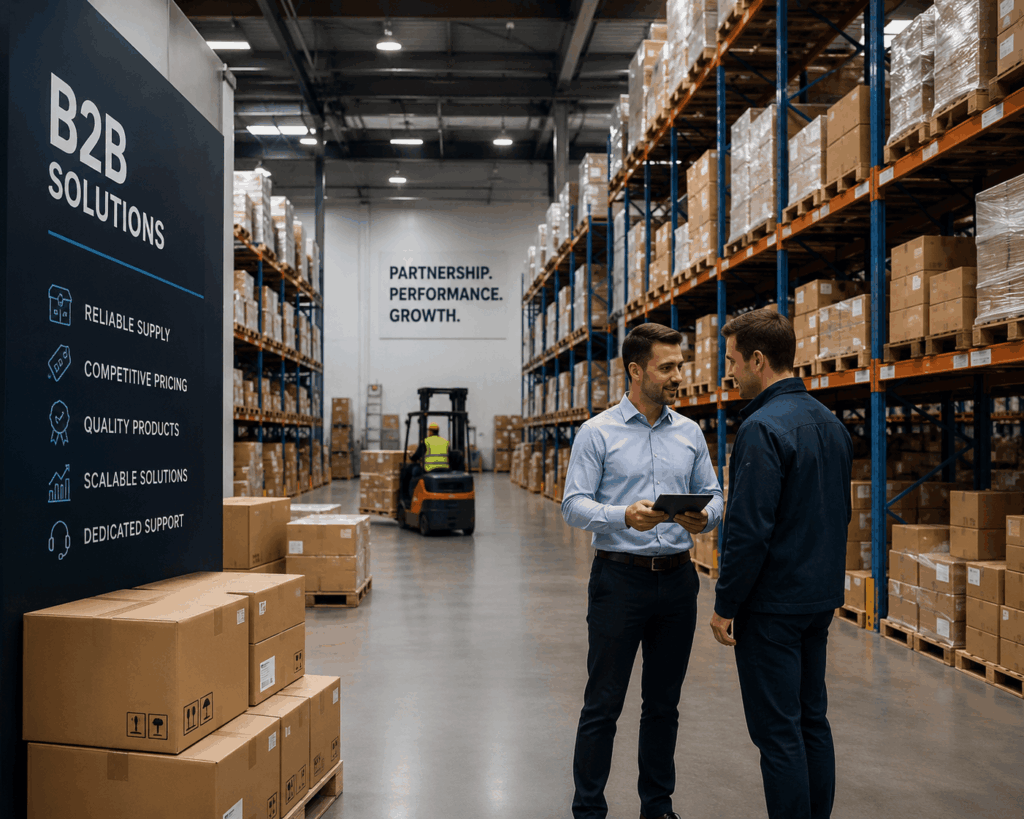
Retail fulfillment is the hardest form of B2B. Each distribution center (DC) has strict receiving rules spelled out in the retailer’s routing guide: appointment windows for when your truck can show up at the dock, specific pallet configurations, labeling and barcode standards, and advance ship notices (ASNs) sent via EDI so the DC knows what’s arriving before it gets there. Miss any of those and the shipment can be refused or hit with a chargeback.
As it is easily understandable, your 3PL can make or break you. In DPWagner, 25 years of proven relationships with all major retailers allow us to help our customers smoothly sail the troubling waters of selling into big retail chains. Contact us and we’ll make it happen together for your brand.
FAQ
What is B2B fulfillment?
B2B fulfillment means shipping bulk orders from one business to another, like a brand supplying a retailer or distributor. The goods move by freight on pallets, not as parcels to shoppers.
How is B2B fulfillment different from B2C?
B2C sends one small package to one consumer, fast. B2B sends pallets to a business, on a set delivery date, with strict rules on labeling and paperwork.
What is a chargeback in retail fulfillment?
A chargeback is a fee a retailer deducts from your payment when a shipment breaks its rules – arriving late, short, or mislabeled. It comes straight out of your margin.
What is EDI and why does it matter?
EDI is the electronic standard for swapping purchase orders, shipping notices, and invoices. Big retailers require it, and many chargebacks start with an EDI mistake.
When should I outsource B2B fulfillment to a 3PL?
Outsource when you’re out of warehouse space, missing delivery windows, or racking up chargebacks. It also helps when you land a big retail account and need compliance handled right.