

DTC vs Wholesale: Choosing the Right Channel Strategy
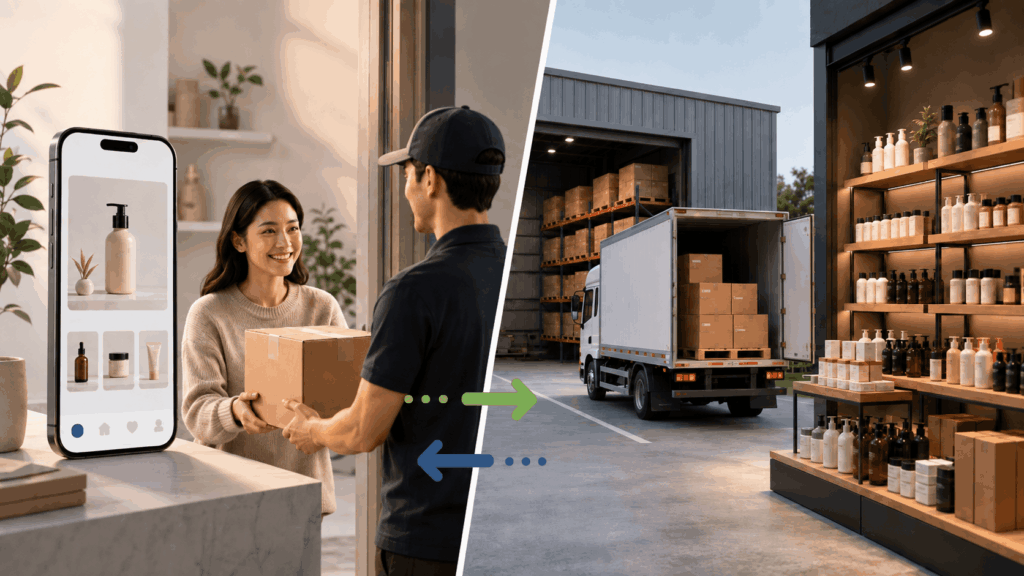
Every growing consumer brand hits the same fork in the road: direct to consumer vs wholesale. Sell straight to the shopper and keep the full margin, or ship pallets into Walmart, Home Depot, and Lowe’s and let their footfall do the selling?
It sounds like a marketing question. It is really an operational question. The channel you pick decides how orders arrive, how products are packed, and how quickly you get paid. Keep reading to get more information and decide which one suits you best.
TL;DR
- Direct to consumer means selling to the end shopper through your own channels. Higher margin per unit and full brand control, but you absorb every cost: acquisition, picking, packing, shipping, and returns.
- Wholesale means selling in bulk to retailers. Lower margin per unit, but far bigger volume, predictable purchase orders, and an audience you did not have to buy.
- The operational gap is wider than the margin gap. Wholesale runs on routing guides, EDI, and on-time-in-full scorecards. DTC runs on single-item picks and parcel shipping.
- Most mature brands run both, and it works when pricing, packaging, and inventory are separated by channel.
Direct To Consumer vs Wholesale Model Differences
The cleanest definition comes from the US Bureau of Labor Statistics: wholesalers sell to retailers and other businesses, while retailers sell directly to consumers. In 2025, wholesale trade accounted for 6.2 million US jobs and retail trade for 16.1 million. Here is how the two compare where it counts.
| Aspect | Direct to Consumer | Wholesale |
| Buyer | The end shopper | A retailer or distributor |
| Order size | One to a few units | Cases, pallets, or truckloads |
| Margin per unit | Full retail price | Often 30% to 50% off retail |
| Customer data | You own it | The retailer owns it |
| Marketing cost | High, and rising | Largely carried by the retailer |
| Cash flow | Paid at checkout | Net terms, often 30 to 90 days |
| Compliance risk | Low | High, with chargebacks for errors |
| Fulfillment profile | Micro-picking, parcel | Case picking, compliant pallets, freight |
That last row is the one brands often underestimate.
What Direct To Consumer Gives You
DTC buys you control. You set the price, own the packaging, test new products in weeks rather than seasons, and talk to customers without a middleman. For personalized or story-heavy products, it is often the only way to explain the value properly. The catch is that acquisition, picking, postage, and returns all come out of that full retail price, so what you actually keep per order is far smaller than the unit margin suggests.
What Wholesale Gives You
Wholesale buys you reach. The National Retail Federation forecasts US retail sales will grow 4.4% in 2026 to $5.6 trillion, and most of that still flows through retailers. One approved SKU at a national chain reaches more shoppers in a week than many DTC campaigns manage in a year.
It also smooths cash flow, since purchase orders are large, scheduled, and repeat when your product sells through. That predictability is what makes B2B fulfillment attractive to brands planning production. The trade-off is control: retailers set the shelf price, the promotion calendar, and the routing guide.
Wholesale vs Direct To Consumer Sales Comparison: The Operational Reality
This is where the two models stop being philosophies and become warehouse floor plans.
A DTC order is one item, picked, boxed, and handed to a parcel carrier. A wholesale order into a big-box retailer is a compliant pallet built to a specified height and pattern, with GS1-128 labels, an advance ship notice sent through EDI, a booked appointment, and a delivery window measured in hours.
Miss any of it and you get a chargeback. That is why retail compliance is the real cost of entry to wholesale, and why plenty of 3PLs built for eCommerce quietly struggle with it. Bin picking software does not build a Home Depot-ready pallet.
The mix also moves over time. Sports brands are the clearest example: after years of pushing hard into direct channels, Nike reported second quarter fiscal 2026 wholesale revenues of $7.5 billion, up 8%, while NIKE Direct fell 8% to $4.6 billion. Even brands with the most direct pulling power keep coming back to the shelf.
Small Business Wholesale vs Direct To Consumer: How To Choose
Four questions usually settle this dilemma.
- Does your product sell itself? Retail buyers want SKUs that move without explanation. If yours needs a demo or a story, start direct.
- Can you fund the working capital gap? Wholesale means producing inventory, shipping it, and waiting on net terms. DTC pays at checkout.
- Is your product a fit for retail handling? Bulky goods, hazmat items, and awkward pack profiles are difficult for standard eCommerce operations, but routine in retail distribution.
- Do you have the compliance muscle? Routing portals, vendor numbers, labeling rules, and OTIF targets are a discipline, not a checkbox.
For most small and mid-sized brands, a good idea is to start where the friction is lowest, and then add the second channel once the first is stable.
Running Both: What The Hybrid Model Demands
Direct-to-consumer vs wholesale is rarely a permanent choice. Selling both ways is common and sensible, and it only goes wrong when the two channels are run as one.
Separate The Offer
Different pack sizes, bundles, or exclusive variants stop your own site from undercutting your retail partners.
Agree On The Promo Calendar
Fix discount dates with your buyers so neither side undercuts the other.
Unify The Inventory View
One real-time picture of stock prevents you from overselling online what a retailer already has on order. This is where sound order management earns its keep.
The hardest part is fulfillment, because the two channels want opposite things from a warehouse. That is why brands increasingly run wholesale distribution through a partner who lives in the retail channel daily, rather than bolting retail requirements onto an eCommerce setup.
Choosing The Channel Is Only Half The Job
Direct to consumer and wholesale are not rivals. They are two different machines, and each rewards brands that build for it properly.
The wholesale side is where we shine. DPWagner has shipped its own retail brands into Walmart, Home Depot, Lowe’s, Menards, and Ace Hardware for more than two decades, so we live retailer compliance, routing portals, and pallet standards from the inside.
Every rule change hits our own products first, and we apply it to client work immediately. We also handle the awkward profiles many 3PLs avoid, including Hazmat Level 2 products, bulky goods, and complex kitting.
Interested in our Services? Get a Custom Quote that completely suits your needs.
GET STARTED!
FAQ
What is the difference between direct to consumer and wholesale?
Direct to consumer means selling to the end shopper through your own channels at full retail price. Wholesale means selling in bulk to retailers at a discount. DTC gives you margin and control, wholesale gives you volume and reach.
Is wholesale or DTC more profitable?
Per unit, DTC wins because you capture the full retail price. Per order, wholesale is often stronger, since one purchase order can cover thousands of units with a single shipment, a single invoice, and no acquisition cost.
Can a small business do both wholesale and direct to consumer?
Yes, and many do. Keep the channels distinct: separate pack sizes or bundles, agreed promotional windows, and one real-time inventory view so online sales do not eat stock promised to a retailer.
Why do sports brands keep shifting between DTC and wholesale?
Direct channels give brands margin and customer data, but growth eventually slows without retail reach. Several major athletic brands that pushed hard into DTC have since rebuilt wholesale accounts, which is why most now run a deliberate mix.
What does a 3PL need to handle wholesale orders?
Retailer-compliant pallet building, case picking, EDI and API integration, routing portal management, correct GS1 labeling, and direct-to-store or direct-to-DC shipping. Check that your provider does these daily, not occasionally.