
What Is Reverse Logistics? How It Works, Types & Strategies
When a shopper returns a bottle of deck cleaner, the story seems to end at the service desk. For the brand that made it, the real work is only starting. That bottle may return weeks later on a pallet from a distribution center (DC), mixed in with overstock from a store reset and a few cases the retailer marked as damaged. Every unit on that pallet needs a decision, and every decision has a price.
Reverse logistics is how those decisions get made: quickly, consistently, and with the margin still intact. For a brand that sells through big-box retailers, that covers far more than shopper returns. It includes unsold stock a buyer sends back at the end of a season, loads a DC turns away at the dock, and recalls that clear a product off shelves nationwide. Each one takes its own route home, with costs worth controlling at every stop.
TL;DR
- Reverse logistics is the flow of goods back up the supply chain, from a customer, store, or DC to the brand or manufacturer.
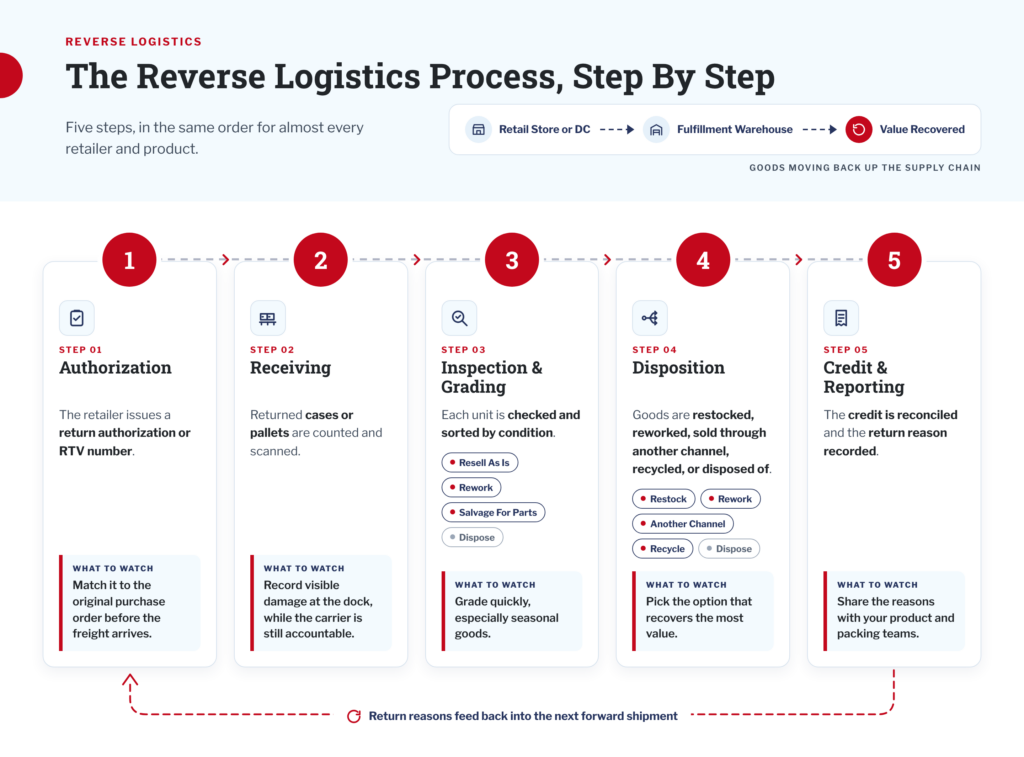
- The reverse logistics process runs in five steps: authorization, receiving, inspection and grading, disposition, and credit and reporting.
- US retail returns reached about $850 billion in 2025, and part of that bill travels back to suppliers.
- Retail suppliers usually get returns by the case or pallet: return to vendor (RTV), overstock, refused loads, recalls, and hazmat returns.
- The biggest gains come from fast grading, one shared inventory record, and checking every deduction against what actually came back.
Reverse Logistics Definition: Goods Moving Back Up The Chain
What is reverse logistics in supply chain management? It is the planning and handling of products that move backward, from the point of sale toward the brand, the manufacturer, or a recovery point, plus what happens to them next: repair, restocking, resale, recycling, or disposal.
For brands selling into big-box retail, one federal definition fits especially well. US hazardous materials rules describe reverse logistics as shipping goods from a retail store back to its manufacturer, supplier, or distribution facility to capture value (such as a manufacturer’s credit), or for a recall, replacement, or recycling.
That is what is meant by reverse logistics for most retail suppliers. In B2B fulfillment, a return behaves more like an inbound shipment than a refund. It has a purchase order behind it, paperwork attached, and a deduction to settle at the end.
Why Reverse Logistics Is Important For Retail Suppliers
US retail returns reached about $850 billion in 2025, and not all of that stops at the store.
Damaged, defective, and unsold goods often come back to the supplier through RTV programs or as a deduction on your next payment. Either way, a slow process costs you:
- Returned pallets take up warehouse space while they wait for a decision.
- Resellable stock loses value while it waits for inspection.
- Unmatched returns turn into deductions that are hard to dispute.
- Repeat problems stay hidden when no one records why goods came back.
The Reverse Logistics Process, Step By Step
What does the reverse logistics process look like in practice? It runs in five steps, in the same order for almost every retailer and product.
Types Of Reverse Logistics, With Examples
Reverse logistics examples look different for a retail supplier than for an online store. Here are the types you will meet most often.
Return To Vendor (RTV) And Defective Goods
A home improvement chain gathers cracked bottles, crushed cartons, and items reported as faulty, then ships them back to the vendor. Some retailers skip the freight and deduct an agreed defective allowance instead, so know which model each buyer uses.
Overstock And Seasonal Returns
After a store reset, the end of a season, or a peak shipping season that was slower than planned, unsold stock can come back in bulk, like outdoor power equipment once summer ends. These goods are often in perfect condition, which makes speed the main concern.
Refused And Undelivered Loads
A DC can turn a shipment away for a wrong label, an oversized pallet, or a missed delivery appointment. The products are fine. The load still has to come back, be rebuilt to the retailer’s current rules, and go out again.
Product Recalls
A recall pulls goods back from every store at once. The US Consumer Product Safety Commission issued 542 recalls and warnings in 2025, 32% more than the year before, and a record for the agency. Recalled stock needs separate storage and a record of what happened to every unit.
Chemical Returns
Household cleaners and similar products follow their own handling rules on the way back, and a leaking container needs trained hands and protective gear before anyone grades the rest of the pallet. That is routine work in our chemical fulfillment operation in Atlanta. Aerosols and bulk high-percentage alcohols are the exception, those go back to a dedicated hazmat facility.
Benefits Of Reverse Logistics Done Right
The benefits of reverse logistics show up across the business:
- Recovered margin: More units go back on the shelf or into a second channel.
- Accurate deductions: Clean records mean you pay back only for the units that actually came back.
- Precise inventory: Returned units count as stock only once they are graded and ready to ship.
- Fewer repeat returns: Return reasons point to the packaging or labeling fix.
- Less waste: Repair, relisting, and recycling keep usable goods out of landfills.
How To Improve Reverse Logistics: 5 Strategies
Know Each Retailer’s Return Terms
Your vendor agreement decides whether the retailer ships goods back or takes a deduction instead, who pays the freight, and how long you have to dispute a claim. Read it before the first order ships.
Keep Forward And Reverse Stock In One System
When returned units land in the same inventory record as outbound stock, a resellable case can ship on the next order.
Grade Within Days, Not Weeks
Value drops while goods wait. A clear grading scale (resell as is, rework, salvage for parts, or dispose) lets the team decide on the spot.
Rework Before You Write Off
Many returns only need a new carton or a fresh label before they can go back on a purchase order, and light disassembly can recover usable parts from the rest.
Match Every Deduction To Its Return
Retailers usually recover the value of returned goods by deducting it from your next payments. Checking each deduction against the RTV number, the original order, and the units that actually arrived helps accounting and AR spot overcharges while there is still time to dispute them.
Returns Handled Inside The Program That Shipped Them
At DPWagner, returns are part of your fulfillment program, not a separate service. The same team that ships your retail orders also grades returned pallets, handles light disassembly or repurposing, and relists stock that is ready to sell. Every unit appears in the same real-time portal as the rest of your inventory, through our technology setup.
Like every vendor in big-box retail, we put our own brands through the same return programs as our clients’ products. So we grade returns the way an owner would: by what each unit can still earn, and how soon.
Interested in our Services? Get a Custom Quote that completely suits your needs.
GET STARTED!
Frequently Asked Questions
What is reverse logistics in simple terms?
It is moving goods backward through the supply chain, from a customer, store, or DC to the brand, so they can be resold, repaired, recycled, or disposed of properly.
What is the difference between reverse logistics and returns management?
Returns management covers the policies and the customer side of a return. Reverse logistics covers the physical side: moving, inspecting, grading, and deciding what happens to the goods.
What does RTV mean in retail?
Return to vendor: a retailer sends damaged, defective, or unsold products back to the supplier, usually for a credit.
Does DPWagner offer reverse logistics as a standalone service?
No. We handle returns, light disassembly, repurposing, and relisting for brands whose retail fulfillment we already run, so forward and reverse inventory stay in one place.